
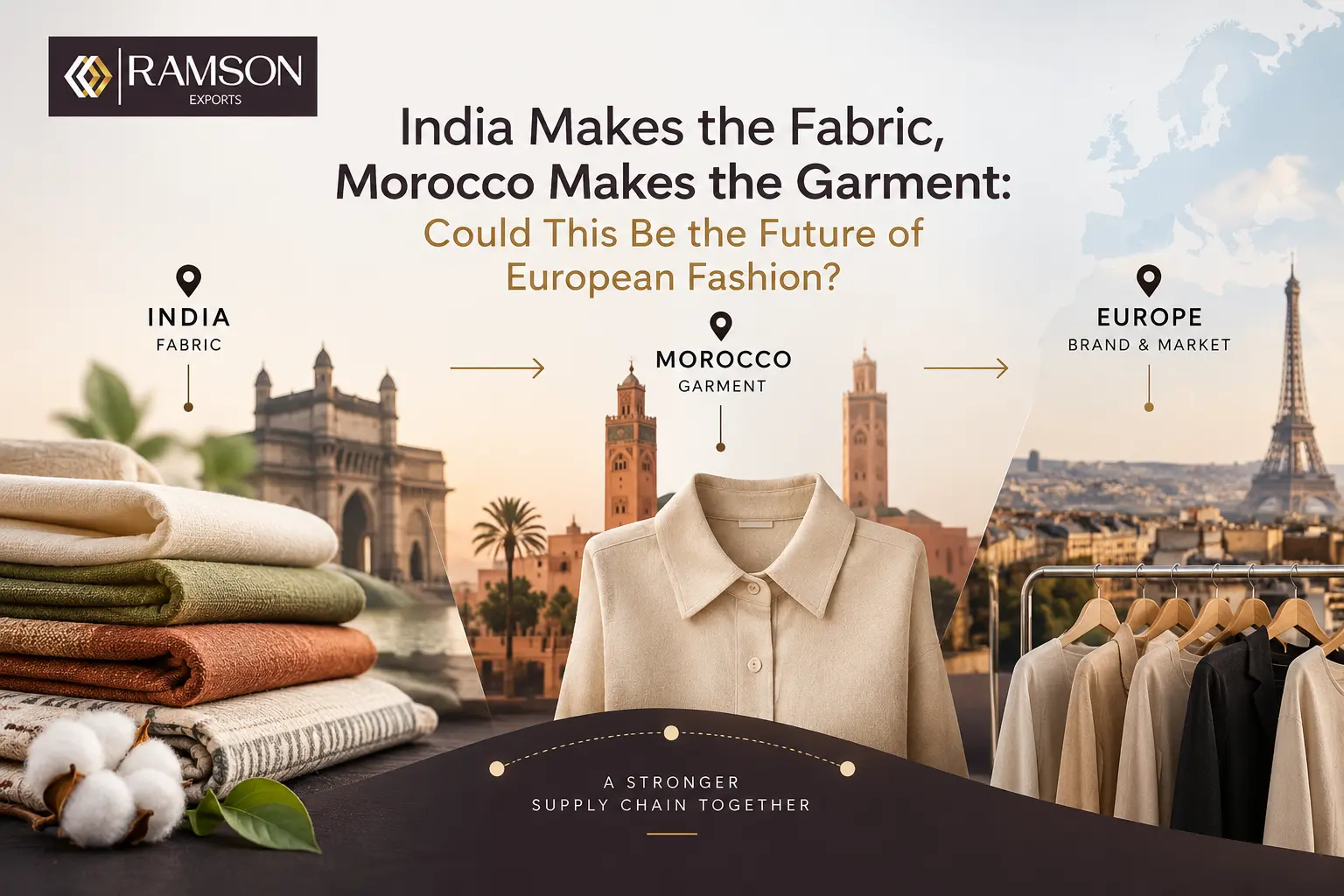
European fashion has always depended on international supply chains, but the next evolution may be less about sourcing everything from one country and more about connecting specialized manufacturing hubs.
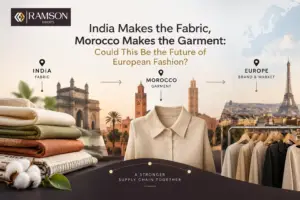
One emerging model is simple: India supplies the fabric, Morocco manufactures the garment, and European brands bring the finished product to market.
This approach combines India’s textile manufacturing capabilities with Morocco’s proximity to the European market. For fashion brands, garment manufacturers and sourcing managers, it raises an important question: could an India–Morocco textile supply chain become a more strategic route for European fashion sourcing?
Why India for Fabric Sourcing?
India has a large and diverse textile manufacturing ecosystem covering fibres, yarns, weaving, printing, dyeing, finishing and fabric development. The country is particularly relevant for buyers looking for variety and customization rather than standardized materials.
European fashion brands and Moroccan garment manufacturers can source fabrics based on composition, GSM, width, colour, finishing, texture and application. Working with an experienced fabric supplier in India can also provide access to customized colours, prints and fabric developments for specific collections.
India is already an important EU trading partner. EU–India goods trade reached €118 billion in 2025, with textiles among the products imported from India. (Trade and Economic Security)
Why Morocco for Garment Manufacturing?
Morocco offers a different advantage: proximity to Europe and an established export-oriented apparel industry.
The EU is Morocco’s largest trading partner, accounting for 33.2% of Morocco’s exports in 2025. Textiles were also one of the major categories of EU imports from Morocco, valued at €2.9 billion. (Trade and Economic Security)
For European fashion businesses, this creates an interesting supply-chain possibility. Fabric development and manufacturing can take place in India, while garment cutting, stitching and finishing can happen closer to the European market in Morocco.
What Makes This Model Attractive?
The key benefit is specialization.
An Indian textile manufacturer can focus on fabric variety, technical specifications, design development and bulk production, while Moroccan garment manufacturers can focus on apparel assembly and export logistics.
However, successful sourcing requires close coordination. Buyers should evaluate fabric composition, GSM, width, colour fastness, shrinkage, finishing, MOQ, sampling, lead time, quality inspection and export documentation.
Rules of origin also need careful consideration because textile supply chains can involve multiple countries and production stages. The EU specifically applies process-based rules of origin to textile products. (Internal Market Hub)
How Ramson Exports Can Help
Ramson Exports can support this evolving supply-chain model by helping international buyers source fabrics from India for bulk garment production. With 15+ years of industry experience, 5,00,000+ metres of monthly production capacity, 25,000+ exclusive designs and a wide range of textile solutions, Ramson can work with buyers on fabric selection, customization and quality requirements. For Moroccan manufacturers and European fashion businesses, this can create a more structured connection between Indian fabric manufacturing and European-focused garment production.
FAQs
1. Why should European fashion brands source fabric from India?
India offers a broad textile manufacturing ecosystem, diverse fabric options and customization capabilities suitable for international fashion production.
2. Why is Morocco attractive for European garment manufacturing?
Morocco’s geographic proximity to Europe and established textile and apparel trade relationships make it an important sourcing location.
3. Can Moroccan garment manufacturers import fabric from India?
Yes. Moroccan manufacturers can source fabrics internationally, subject to applicable customs, documentation, logistics and rules-of-origin requirements.
4. What should buyers check when sourcing fabric from India?
Important factors include GSM, composition, width, colour fastness, shrinkage, finishing, MOQ, sampling, quality consistency and production lead time.
5. Can Ramson Exports supply fabric for Moroccan garment manufacturers?
Ramson Exports provides B2B textile sourcing and customized fabric solutions for international buyers, including bulk requirements for garment production.