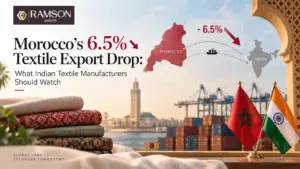

Morocco’s textile and leather exports fell by 6.5% in the first half of 2026, even as the country’s overall exports grew by 9.7%. For Indian textile manufacturers and fabric exporters, this is more than just a market statistic — it is a signal worth watching. (North Africa Post)
Between January and June 2026, Morocco’s textile and leather exports reached approximately MAD 21.07 billion, down from the previous year. Ready-made garment exports declined 5.7%, while knitwear exports fell 9.7%. (North Africa Post)
For businesses involved in India–Morocco textile trade, the question is what this change means for future fabric sourcing.
What Is Driving the Change?
Morocco’s export performance is becoming increasingly uneven across industries. While textile and leather exports declined, automotive exports increased 17.4% and aerospace exports rose 19.3% during the same period. (HESPRESS English – Morocco News)
This does not necessarily mean Morocco’s garment industry is disappearing. Instead, it highlights increasing competition and pressure on traditional export sectors.
Moroccan garment manufacturers supplying European markets may therefore need to focus more strongly on product differentiation, quality, speed and cost efficiency.
This is where the choice of fabric supplier becomes increasingly important.
Why Indian Textile Manufacturers Should Pay Attention
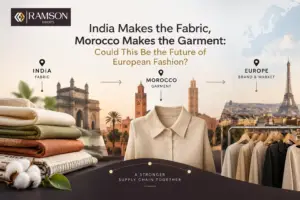
For Indian textile manufacturers and fabric exporters, Morocco remains a market worth monitoring because its apparel industry is closely connected to European fashion supply chains.
When garment manufacturers face pressure on export margins, fabric sourcing becomes an important area for efficiency. Buyers may look for suppliers offering consistent quality, competitive bulk pricing, customization and dependable lead times.
Indian fabric suppliers can potentially support this requirement through a broad range of fabrics, including jacquards, printed fabrics, satin, linen blends, embroidery fabrics and other fashion textiles.
However, competing on price alone is not enough. Moroccan buyers increasingly need fabric partners who can maintain consistency across repeat orders and meet specific technical requirements.
What Should Indian Suppliers Watch?
Indian textile exporters targeting Morocco should monitor three areas: buyer demand, product positioning and supply-chain efficiency.
Fabric specifications such as GSM, composition, width, colour fastness, shrinkage and finishing can directly affect garment production. Sampling and approval processes also need to be managed efficiently to avoid production delays.
Export documentation, packaging, MOQ and lead time are equally important when supplying fabrics internationally.
The bigger opportunity may be in helping Moroccan manufacturers move toward higher-value fashion products rather than simply competing in basic garment production. Industry observers have similarly pointed toward higher-value apparel and technical textiles as potential areas for Morocco’s textile sector. (North Africa Post)
How Ramson Exports Can Help
Ramson Exports can help international and Moroccan garment manufacturers source fabrics from India with a focus on consistency, customization and bulk production. With 15+ years of industry experience, 5,00,000+ metres of monthly production capacity, 25,000+ exclusive designs and export experience across 10+ countries, Ramson can support buyers looking for a dependable textile manufacturing partner. From fabric selection and customized developments to quality checking before dispatch, Ramson can help make India–Morocco fabric sourcing more structured and reliable.
FAQs
1. Why did Morocco’s textile exports fall by 6.5%?
Morocco’s textile and leather exports declined 6.5% in the first half of 2026, with ready-made garments and knitwear both recording declines. The available trade data shows the decline but does not establish one single cause. (North Africa Post)
2. Is Morocco still an important market for Indian textile exporters?
Yes. Morocco’s established garment industry and strong links with European fashion markets make it a relevant destination for Indian fabric manufacturers and exporters.
3. What fabrics can Indian suppliers export to Morocco?
Depending on the supplier, Moroccan buyers can source jacquard, satin, printed fabrics, linen blends, embroidery fabrics and various fashion textiles from India.
4. What should Moroccan buyers consider when choosing an Indian fabric supplier?
Important factors include fabric composition, GSM, width, colour fastness, shrinkage, finishing, MOQ, sampling, lead time, quality inspection and export documentation.
5. How can Ramson Exports support Moroccan garment manufacturers?
Ramson Exports provides bulk fabric sourcing and customized textile solutions, supporting international buyers with fabric variety, production capacity, quality checking and export capabilities.